Showing posts with label History's. Show all posts

Sunday, 20 October 2013

What People Did For Fun Before The Internet
13:47 0 comments

BY NEHA PRAKASH

It's a sad truth, but the Internet consumes our lives. A day without Netflix, a moment without email or a second without Google is beyond imagination.
But there once was a time — many, many years ago (but not really that long) — when humans had to find a non-web-based form of entertainment.
Originally published on Mashable
In this Sunday comic, Nitrozac and Snaggy of The Joy of Tech imagine how our prehistoric ancestors wasted time without the luxury of social media.

Comic illustration provided by The Joy of Tech

First Evidence Found Of A Comet Strike On Earth
13:30 0 comments

Comet exploded 28 million years ago over Egypt, new study suggests.

By Andrew Fazekas
Image : Gustav Verderber/Visuals Unlimit

Saharan glass and a brooch belonging to King Tut provide the first evidence of a comet directly impacting Earth, a new study claims. The finding may help unlock some of the mysteries surrounding the birth of our solar system.

About 28 million years ago a comet exploded over Egypt, creating a 3600°F (2000°C) blast wave that spread out over the desert below. The fiery shockwave melted the sand, forming copious amounts of yellow silica glass scattered over 2,300 square miles (6,000 square kilometers) of the Sahara.

Polished into the shape of a scarab beetle, a large piece of this glass found its way into a brooch owned by the famed Egyptian boy king Tutankhamen.

"Because there is no sign of an impact crater, it has been a mystery as to what kind of celestial event actually could have caused this debris field, but a small, black stone found lying in the middle of the glass area caught our attention," said study co-author David Block, an astronomer at Wits University in Johannesburg, South Africa.

Originally published on National Geographic


Saharan Surprise

A tiny slice of the black pebble was put through isotopic analysis, which definitely ruled out that it came from a meteor. Instead, the analysis showed that the pebble possessed the unique chemical signature of a comet, measured in terms of elements such as argon and carbon.

"It was then basically a matter of running the movie backwards in time and predicting what temperatures were needed to create the conditions we find that make up the fragment today," Block says. "So when I saw the result of the analyses, I was completely ecstatic to realize that such a piece of cosmic history has been found for the first time right on our doorstep."

While meteors are known to enter the Earth's atmosphere frequently—one can be seen as a shooting star every 15 minutes or so on any random night—not so with comets.

The implosions of comets in planetary atmospheres are exceedingly rare events—the only other definitive case of a comet hitting a planet was back in 1994 when comet Shoemaker-Levy 9 impacted Jupiter's atmosphere.


Astronomical Odds Inspire Caution

And it's because of this rarity that Earth scientist Andrew Glikson of the Australian National University in Canberra, who was not involved in this study, questions if these yellow glass objects, called tektites, might instead have been created through much more common meteoric events, as seen at many impact sites around the world.

"Why can't the material represent a large tektite formed by heating and melting of sand at the Earth's surface by an asteroid impact, such as, for example, the Australite tektites?" asks Glikson.

While this extraterrestrial glass is considered common around many impact sites,  geologist Gerald Johnson, who was not involved in the study, says that beyond the compelling evidence the team presents in their chemical workup of the black pebble, it's not surprising that the research community may be wary of these results.

"A comet, mostly water, vaporizes in the atmosphere and leaves little for the geologic record, while the 'dirt' incorporated in the comet also is disseminated widely and is unlikely to be found because of impact dispersal, surface weathering, and erosion," said Johnson, a meteor impact researcher at the College of William and Mary in Williamsburg, Virginia.

"Undoubtedly, the Earth has been hit numerous times by comets, but our knowledge of these is lacking because comets leave such a poor record ... so this discovery is amazing."


Solar System Origins

Microscopic dust particles from these icy interlopers have been collected from the upper atmosphere and from Antarctic ice, and have been scooped up by space probes.
But having a chance to study sizable comet material firsthand would be exceptional, and Block and his team believe it can offer a unique chance to study the birth of our solar system.
Cosmic particles called presolar grains formed in the stellar cloud of gas and dust that gave birth to our solar system, and are thought to have remained within comets and meteors.
"My bet is that this little rock will unlock some unique secrets in time to come, specifically because it appears packed with presolar grains," said Block.
The comet study will be published in an upcoming issue of Earth and Planetary Science Letters.

Please share and leave your comment below:

Monday, 14 October 2013

Lost Kings: DNA Fails to Illuminate Royal Mystery
00:22 0 comments


A skeleton buried under a parking lot. A grotesque mummy head. A gourd encrusted with mysterious blood.
These three disturbing objects have something in common: All have been identified as belonging to long-dead kings, in part using DNA evidence. But despite DNA's reputation as a forensic smoking gun, only one — the skeleton — has escaped serious controversy.
The skeleton, widely accepted as the earthly remains of the English King Richard III, is a bright spot in the often-murky world of ancient DNA identification. Archaeologists identified the body based on multiple lines of evidence, from historical records to telltale battle wounds. On top of it all, the skeleton's DNA matched a living relative of the king's.
The tale of the head and the gourd, however, is not quite so straightforward. In 2010, a forensic analysis suggested the head belonged to French King Henry IV. DNA later linked the head to the blood in the gourd, leading researchers to identify the blood's owner as Henry's descendant, French King Louis XVI. Now, however, a second DNA analysis has thrown those findings into disarray, suggesting perhaps the head and the blood belong not to royalty, but to nobodies.
The cases reveal the controversy of using DNA to identify the long-dead. And they highlight the problems inherent in studying celebrity corpses: At what point can scientists be sure enough that a contested body part deserves a royal burial?

Calls For Caution
Image : examiner

The case of Richard III is a prime example. The identification of the skeleton, unearthed in Leicester, England, triggered worldwide interest. As the villainous star of a Shakespeare play, Richard III had built-in name recognition and an international fan base passionate about rehabilitating his reputation.
Every piece of evidence pointed to the skeleton belonging to Richard. Wounds on the bones matched historical records of Richard's life and death. The location of the grave was where it was expected to be. Even DNA testing suggested the skeleton was the medieval king.
It was the DNA identification that grabbed headlines, perhaps because shows like CSI portray DNA testing as the height of certainty. But scientists called for caution.
"It seems to me that osteological as well as archaeological evidence is stronger; however, 'DNA evidence' sounds fancier so it looks like they used it as the hook to capture the attention of media," Maria Avila, a computational biologist at the Center for GeoGenetics at the Natural History Museum of Denmark, told LiveScience at the time. Though Avila did not doubt the identification, she warned that close scrutiny is required to be sure of any ancient DNA finding.

Tricky Identification
Image : futuristicnews

DNA, which serves as the building and operating instructions for the body, is also a handy way to pinpoint identity — assuming the molecule is in good shape. Ancient DNA, or aDNA, as it's known in the shorthand of scientists, is typically degraded. Teasing useful genetic sequences out of a crumbling, fragmented genome can take decades.
"A nice example is the number of years they needed to identify original Neanderthal DNA in the sample they had," said Jean-Jacques Cassiman, a geneticist at the University of Leuven in Belgium who published a recent study calling into question the identifications of King Henry IV and King Louis XVI. "It took them years of work, of hard work."
The Neanderthal Genome Project, established with the goal of sequencing a full Neanderthal genome, was founded in 2006 after the individual scientists involved had already published several attempts at decoding this extinct human relative's genome. It wasn't until 2010 that the collaboration published a full first draft of the genome.
Part of the challenge, Cassiman said, is contamination. Hair, skin flakes and other DNA-bearing bits of modern humans can accidentally end up mixed in the aDNA samples, overwhelming them.
"Ancient DNA is fragmented compared to the contaminating DNA," Cassiman said. "There's very little."

A Tale of Two Kings
Image : wikipedia

Whereas DNA was just a piece of the puzzle linking the Leicester bones to Richard III, when the molecule is the whole case and other evidence is hazy, genetic identifications become more difficult.
The tale of two French kings is a case in point. In 2010, osteoarchaeologist Philippe Charlier of University Hospital R PoincarĂ© in Garches, France, launched a forensic investigation of a grotesque mummy head owned by private collectors. The head was rumored to belong to Henry IV, who ruled France from 1589 to 1610, and famously converted from Protestantism to Catholicism to smooth his ascent to the throne.
Centuries later, during the French Revolution, the graves of long-dead kings were ransacked and the bodies mutilated and reburied in unmarked pits. Some accounts held that Henry IV was among the disinterred, and his head was cut off in the process.
Meanwhile, Henry IV's descendent Louis XVI met with a similar fate as the Revolution raged — though beheading was perhaps more traumatic for Louis, as he was alive at the time. Witnesses to Louis XVI's execution were said to have soaked handkerchiefs in his blood. One of these handkerchiefs supposedly ended up in a decorative gourd owned by an Italian family.
Charlier and his colleagues digitally reconstructed a face based on the bone structure and muscle attachments of the mummy head. According to their work, published in December 2012 in the British Medical Journal, the mummy's features matched those of a cast, or death mask, made of Henry IV's face made just after his death. Later, Charlier extracted DNA from the mummified head.
Earlier this year, scientists led by Carles Lalueza-Fox, a paleogenomics researcher at Pompeu Fabra University in Spain, compared DNA from the head with DNA from the blood found in the gourd. They found a match along the Y chromosome, leading them to announce that the owner of the head and the owner of the blood were related. As the head was thought to be Henry IV's, the blood seemed likely to be his direct descendent Louis XVI's.

DNA Drawbacks
Image : weeklyworldnews

Or not. Cassiman's new analysis, published in the European Journal of Human Genetics, argues that neither the blood nor the head came from members of the House of Bourbon, the lineage of Henry IV and Louis XVI.
Cassiman's conclusions are drawn from a comparison of the DNA from the blood and the head with the DNA of three living Bourbon descendants. The living descendants, from different branches of the family, share a Y-chromosome subgroup called R-Z381*. Rather than that subgroup, the Y chromosome found in the blood belongs to a group called G(xG1, G2). The most recent common ancestor linking the two groups would have lived about 10,000 years ago, the researchers calculated. The blood, then, appears to belong to an individual unrelated to Louis XVI.
Because the blood is not from a Bourbon, comparing it with the DNA from the mummified head to make an identification is "completely crazy," Cassiman said.
"You cannot identify two unknowns from two unknowns," he said.
The owner of the head does not appear related to the owner of the blood nor to the living Bourbons through either maternal or paternal lines, he added.
Lalueza-Fox, who led the identification of the blood, said the original conclusions were based on a partial match on the Y chromosome between the blood and the head. However, a single marker that could have been missed in the processing of the DNA would have immediately shown that there was no relation.
"Maybe we were just unlucky," Lalueza-Fox told LiveScience.
"Right now, the most parsimonious [explanation] would be that both Louis XVI's blood and Henry IV's head are false and that the possible paternal relationship we found among both remains is spurious," he said.
Charlier, who originally identified the mummy head as Henry IV's, is not backing down, however.
"We think it's entirely impossible to try to fit, exactly, a genealogic tree to genetic data," he toldLiveScience.
Charlier argues that "nonpaternity events" — when a man raises a child unaware that it is not really his own — make families less genetically linear than a family tree would suggest. Over a period of 600 years or so, he said, familial DNA is bound to diverge from the expected pattern.
"The definition of a family in France is to live in the same house, not to have clearly the same genetic patrimony as the parents," Charlier wrote in an email to LiveScience, using wording he plans to submit to the European Journal of Human Genetics in response to Cassiman's findings.
Cassiman said paternity concerns aren't an issue, because the three living Bourbons share a Y chromosome, suggesting the family line is not broken by illegitimate children.

Unsolved Mysteries
Image : paranormal

What's more, Cassiman said, historical evidence does not point to the head as Henry IV's. Historians are not all convinced that Henry IV's body was among those mutilated in the French Revolution.
But Cassiman's DNA analysis is not irrefutable proof that the head isn't Henry's, either. To come to a definitive conclusion via genetics would take years of work, he said, calling Charlier's conclusions, "a bit too quick."
"If they would ask me to do something more, I would need a serious budget, because I know it's going to take me months and years in order to make something that is believable, that's reliable from this," Cassiman said.
Among Cassiman's concerns is the contamination of the fragile DNA in the head. A documentary aired in France about the identification of the head showed alarming practices during the analysis, he said.
"There are people sniffing on this head, hanging over it, touching it with their nose," he said. "It's completely crazy. I really get upset when I see this."
For now, the researchers are at an impasse. Cassiman argues his DNA findings make it certain the head is not Henry's. Charlier argues the 3D match between the skull and Henry IV's death mask mean it could be no one else's.
Further research may be stymied by conditions unique to the head, Lalueza-Fox added. The first is historical uncertainty about the location of the bodies — no one is sure where Henry IV's remains are. The second are the substances used to embalm the head.
"These substances likely degrade further the DNA or prevent their retrieval, making the analysis of relatively recent specimens more challenging than, for instance, prehistoric remains," Lalueza-Fox said.
So while Britain turns to a debate regarding where Richard III's royal reburial will be, the head of possibly Henry IV (or possibly some random Frenchman) will remain in limbo, Charlier said.
"Sincerely I think this study for me is quite finished, and the story is quite finished because there will still remain, for everybody, a doubt," Charlier said.
Appeared on LiveScience 

Friday, 11 October 2013

Steve Jobs Convincingly Dismiss Tablets 10 Years Ago
11:32 0 comments


Image : hdwallfan


It has only been three years of years since Apple introduced the iPad, and it has been a tremendous success ever since. That makes it all the more interesting to hear Steve Jobs convincingly dismiss tablets, at the first All Things Digital conference in 2003, ten years ago, to Walt Mossberg.
“It turns out people want keyboards”… “We look at the tablet and we think it’s gonna fail”… Now, 2003 was a different era to 2010, but it’s interesting to see how our perceptions of what makes sense in terms of technology change over time. That said, Mossberg and Jobs agree that the tablet is a better reading device than anything with a clamshell format, but Jobs doesn’t think the market for a ‘third computer’ is big enough. How times changed.

Wednesday, 9 October 2013

Were the First Artists Mostly Women?
07:18 0 comments


    Handprints in ancient cave art most often belonged to women, overturning the dogma that the earliest artists
     were all men.

This article originally appeared on National Geographic.

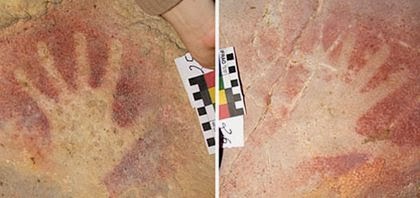
Women made most of the oldest-known cave art paintings, suggests a new analysis of ancient handprints. Most scholars had assumed these ancient artists were predominantly men, so the finding overturns decades of archaeological dogma.
Archaeologist Dean Snow of Pennsylvania State University analyzed hand stencils found in eight cave sites in France and Spain. By comparing the relative lengths of certain fingers, Snow determined that three-quarters of the handprints were female.
"There has been a male bias in the literature for a long time," said Snow, whose research was supported by the National Geographic Society's Committee for Research and Exploration. "People have made a lot of unwarranted assumptions about who made these things, and why."
Archaeologists have found hundreds of hand stencils on cave walls across the world. Because many of these early paintings also showcase game animals—bison, reindeer, horses, woolly mammoths—many researchers have proposed that they were made by male hunters, perhaps to chronicle their kills or as some kind of "hunting magic" to improve success of an upcoming hunt. The new study suggests otherwise.
"In most hunter-gatherer societies, it's men that do the killing. But it's often the women who haul the meat back to camp, and women are as concerned with the productivity of the hunt as the men are," Snow said. "It wasn't just a bunch of guys out there chasing bison around."
Experts expressed a wide range of opinions about how to interpret Snow's new data, attesting to the many mysteries still surrounding this early art.
"Hand stencils are a truly ironic category of cave art because they appear to be such a clear and obvious connection between us and the people of the Paleolithic," said archaeologist Paul Pettitt of Durham University in England. "We think we understand them, yet the more you dig into them you realize how superficial our understanding is."

Sex Differences
Snow's study began more than a decade ago when he came across the work of John Manning, a British biologist who had found that men and women differ in the relative lengths of their fingers: Women tend to have ring and index fingers of about the same length, whereas men's ring fingers tend to be longer than their index fingers.
    These hand stencils found in the El Castillo cave in Cantabria, Spain, were probably made by a man (left) and a
      woman (right), respectively.

One day after reading about Manning's studies, Snow pulled a 40-year-old book about cave paintings off his bookshelf. The inside front cover of the book showed a colorful hand stencil from the famous Pech Merle cave in southern France. "I looked at that thing and I thought, man, if Manning knows what he's talking about, then this is almost certainly a female hand," Snow recalled.
Hand stencils and handprints have been found in caves in Argentina, Africa, Borneo, and Australia. But the most famous examples are from the 12,000- to 40,000-year-old cave paintings in southern France and northern Spain. (See "Pictures: Hand Stencils Through Time.")
For the new study, out this week in the journal American Antiquity, Snow examined hundreds of stencils in European caves, but most were too faint or smudged to use in the analysis. The study includes measurements from 32 stencils, including 16 from the cave of El Castillo in Spain, 6 from the caves of Gargas in France, and 5 from Pech Merle.
Snow ran the numbers through an algorithm that he had created based on a reference set of hands from people of European descent who lived near his university. Using several measurements—such as the length of the fingers, the length of the hand, the ratio of ring to index finger, and the ratio of index finger to little finger—the algorithm could predict whether a given handprint was male or female. Because there is a lot of overlap between men and women, however, the algorithm wasn't especially precise: It predicted the sex of Snow's modern sample with about 60 percent accuracy.
Luckily for Snow, that wasn't a problem for the analysis of the prehistoric handprints. As it turned out—much to his surprise—the hands in the caves were much more sexually dimorphic than modern hands, meaning that there was little overlap in the various hand measurements.
"They fall at the extreme ends, and even beyond the extreme ends," Snow said. "Twenty thousand years ago, men were men and women were women."

Woman, Boy, Shaman?
Snow's analysis determined that 24 of the 32 hands—75 percent—were female. (See "Pictures: Prehistoric European Cave Artists Were Female.")
Some experts are skeptical. Several years ago, evolutionary biologist R. Dale Guthrie performed a similar analysis of Paleolithic handprints. His work—based mostly on differences in the width of the palm and the thumb—found that the vast majority of handprints came from adolescent boys.
For adults, caves would have been dangerous and uninteresting, but young boys would have explored them for adventure, said Guthrie, an emeritus professor at the University of Alaska, Fairbanks. "They drew what was on their mind, which is mainly two things: naked women and large, frightening mammals."
Other researchers are more convinced by the new data.
"I think the article is a landmark contribution," said archaeologist Dave Whitley of ASM Affiliates, an archaeological consulting firm in Tehachapi, California. Despite these handprints being discussed for half a decade, "this is the first time anyone's synthesized a good body of evidence."
Whitley rejects Guthrie's idea that this art was made for purely practical reasons related to hunting. His view is that most of the art was made by shamans who went into trances to try to connect with the spirit world. "If you go into one of these caves alone, you start to suffer from sensory deprivation very, very quickly, in 5 to 10 minutes," Whitley said. "It can spin you into an altered state of consciousness."
The new study doesn't discount the shaman theory, Whitley added, because in some hunter-gatherer societies shamans are female or even transgendered.
The new work raises many more questions than it answers. Why would women be the primary artists? Were they creating only the handprints, or the rest of the art as well? Would the hand analysis hold up if the artists weren't human, but Neanderthal?
The question Snow gets most often, though, is why these ancient artists, whoever they were, left handprints at all.
"I have no idea, but a pretty good hypothesis is that this is somebody saying, 'This is mine, I did this,'" he said.


Ads