Showing posts with label Work's. Show all posts

Sunday, 20 October 2013

How to Job Hunt While Still Employed
03:26 0 comments

BY JENNIFER PARRIS
Image: flickr, Victor1558
It obviously makes more sense to look for a job while you still have one. After all, you won’t feel the pressure to pick any old job that you’re offered because you have to pay your mortgage, car loan, credit card bills or because the gap between jobs on your resume is growing wider and wider. That said, job hunting while you’re still working can present its own set of prickly problems. Here’s how to safely look for a new job — without risking the one you currently have.
Don’t be obvious. The last thing you want to do is alert your current boss that you are job hunting. Even if you already have one foot out the door, don’t be too obvious about your job searching efforts. Schedule your interviews before or after work, or if you have to, take a day off and try to bundle them together. After all, if you show up to work in a three-piece suit (and your normal attire is jeans and a tee shirt), you’re going to attract some very unnecessary attention at the office.
Don’t tell your coworkers. You might be tempted to tell your colleagues and work bestie about your job search. But sharing the news, even with a couple of close office friends, could potentially result in your boss finding out about your plans a lot sooner than you’d like. Some companies can even let you go if they find out that you’re seeking employment elsewhere. And at the very least, your boss can make your life miserable while you’re still there, forcing you to quit before you’re ready.
Don’t use office equipment. After a brutal meeting with your boss, you might be tempted to storm back to your cubicle and openly — and passive aggressively — troll job boards. Not a good idea. Your company most likely has tracking programs built into your computer or can search your history to see the sites you’ve been on. So save your job searching — and applying — for after work.
Review your references. It’s important to tell the hiring managers at the beginning of your job interviews that you’re currently employed. You definitely don’t want them to reach out to your boss for a reference, so find a few previous bosses or colleagues who are not directly connected to your company to provide references for you. Above all else, be sure that your prospective employer knows that you would like to keep your job search confidential.
Excel in your current job. Between searching through job ads, constructing meaningful cover letters and interviewing, your full focus is on finding a job. Don’t let your job performance suffer as a result, though. If you’ve been an exemplary employee in your current job, you don’t want the last few weeks before you resign to reflect poorly on your overall performance with the company. Even though job hunting can be a second job in and of itself, you want to make sure that you give your job 100% each day. That way, you can use the job as a reference in the future.
Job hunting while you have a current job can be tricky, but if you are cautious, careful, and above all, respectful, you’ll be successful — and not burn any bridges in the process.


Saturday, 19 October 2013

4 Ways Entrepreneurs Can Amplify Content On LinkedIn
02:19 0 comments

BY RYAN LYTLE
Image: Bloomberg via Getty Images

LinkedIn launched in 2003 as the social network of choice for professionals, and as a landmark of sorts for those who wanted an online space for their resume.
Since then, the platform has grown to more than 225 million users across the world, who use LinkedIn not only as a place to showcase career skills and ambitions, but also to have conversations around specific topics in the more than 1.8 million groups, look for new jobs and get news about their areas of interest.
Originally posted on Mashable
When LinkedIn Today launched in 2011, it marked a major shift in how users would interact with the platform, and also quickly transformed LinkedIn into a publishing powerhouse. This was reinforced with the introduction of LinkedIn Influencers, a feature that gives hundreds of the world’s top thought leaders a forum through which share their professional insights with the network.
Although many of these updates in publishing strategy have notably benefited media organizations and well-known individuals, many entrepreneurs and business owners have also seen great opportunities for sharing their own content.
“If you’re an entrepreneur, and you only have time for one social network, I would choose LinkedIn over any other,” says Dave Kerpen, founder and CEO of Likeable Local, a social media software startup for small businesses, and a LinkedIn Influencer with roughly 220,000 followers. “LinkedIn will undoubtedly give you the biggest bang for your buck.”
For entrepreneurs who are looking to make a bigger splash on LinkedIn, these four strategies will help get you on the right path.
1. Do the Basics
With LinkedIn’s many groups, updated publishing features and new content tools, there are a variety of options for entrepreneurs who want to be more active on LinkedIn. But individuals should still be cognizant of how their overall profiles look to other users on the network.
For those who have been lurkers on LinkedIn, just adding a profile picture to your account, for example, makes your profile seven times more likely to be viewed by others, according to LinkedIn data.
“It doesn’t take a lot of effort to maintain your profile,” says Alexis Grant, founder of Socialexis, a digital strategy company for small businesses. “Once you’ve done that initial foundation building, you can get a big return without doing much.”
But beyond filling out a profile with a powerful, keyword-filled summary, as well as skills and experiences, entrepreneurs should strongly consider the type of content they share to LinkedIn, much as they would with Facebook or Twitter, Kerpen says.
“I use LinkedIn as a way to distribute great content, and I usually share six to eight updates on LinkedIn each day,” he says. “I’ve only gotten feedback from one person out of my 218,000 followers and more than 10,000 connections that I share too much.”
So what status updates perform well on the social network? "I share inspirational quotes and links to articles, both that I or my company has written or that I come across, that I think will be helpful," Kerpen notes. "I read everything that I share because I believe I have a responsibility to share good, useful content."
2. Find Value in LinkedIn Groups
With nearly 2 million LinkedIn Groups, a user can find conversations for nearly any topic –- from “Food Industry Jobs” to “Australian Football” to “On Startups,” among many others.
For entrepreneurs, LinkedIn Groups can be a valuable opportunity to join vibrant conversations and identify valuable connections, but it can also damage your brand by marketing yourself too much.
"Groups are the main feature I use on LinkedIn," says Grant. "But some of those groups can get a little too noisy to share valuable information."
“You just have to make sure you're adding true value to these groups,” Kerpen adds. "You see a lot of people posting inappropriate content or trying to promote themselves too much.”
To control the conversation, as opposed to lending a voice to a noisy conversation, some entrepreneurs have created their own LinkedIn Groups around their business area or backgrounds.
“If there’s a gap in the conversation to create a niche group, I think it’s a great opportunity for entrepreneurs and business owners,” Grant says. “And if you own a group, you can send [announcements] to group members.”
That point may be most appealing to entrepreneurs –- the ability to send messages to group members in a form of an announcement. While you may not be able to brand these messages much like a custom newsletter, they could help spread your message and content to potential clients and customers at no cost to you or your business.
3. Don't Underestimate the Influence of SlideShare
LinkedIn acquired professional content sharing platform SlideShare in 2012. The purchase not only made sense from a user base perspective –- SlideShare sees more than 50 million unique visitors each month -– but the platform, which allows users to upload and share presentations, infographics and videos, adds a much-needed visual element to the very text-heavy LinkedIn site.
But SlideShare offers entrepreneurs on LinkedIn much more than just a visual element. “SlideShare has been the most powerful professional tool I have ever used,” says Tara Hunt, a LinkedIn Influencer and co-founder of the social strategy firm Lime Foundry. “SlideShare is all of the smart things you have to say about a topic in one clickable deck.”
SlideShare has helped Hunt improve her presentations, too. "I would never have talking points on my slides," she notes. "It would be 26 pages of images that would serve as visual cues during a live presentation. My decks are now able to be standalones on the platform."
And Slideshare can be a major business driver for some entrepreneurs, Likeable Local’s Kerpen says. “The number one and number two business drivers for my companies are SlideShare and LinkedIn.”
4. Understand the Power of Being a LinkedIn Influencer
There are now more than 300 LinkedIn Influencers, which is comprised of some of the world’s top thought leaders across a variety of industries. When promoted through the LinkedIn Today news platform, longform posts from these Influencers can have a wide reach.
In fact, the average Influencer post gets up to 25,000 views and nearly 100 comments. “The LinkedIn Influencer program allows thought leaders to have an even wider distribution platform on LinkedIn,” Kerpen says. “Through this and LinkedIn Today, LinkedIn has built a publishing platform like we've never seen.”
For entrepreneurs who are starting new companies or partnerships, the LinkedIn Influencer program “is a great platform to expand the reach” of the brand’s message, Hunt says. “You’re looked at as an authority on the matter, so you get a sort of social boost with that.”
Although LinkedIn is not accepting applications for new Influencers at this time, you don't need to be a part of this program to have a major impact on LinkedIn, Kerpen notes.
“The only major difference is that the LinkedIn Influencer program gives me a longer-form opportunity and a wider distribution network,” he adds. “I don’t mean to take these two for granted, but everyone can share original content on this network.”
Are you LinkedIn user? What your experience by using LinkedIn product? Share with us:

What Social Media Can (Really) Tell You About Job Applicants
00:46 0 comments


It's no secret that employers research job candidates' social media profiles to help them make hiring decisions. Most employers, however, may have been inaccurately evaluating applicants' online personas all along: New research has found that employers who quickly dismiss applicants based on unpleasant status updates and incriminating photos from a trip to Vegas may actually be missing out on great talent.
The study, "Big Five Personality Traits Reflected in Job Applicants' Social Media Postings," identified links between job applicants' online behaviors and characteristics that might impact their work performance.
Unfiltered personal communications and photos, comments about others, and references to alcohol and drug use are the key indicators of personality traits that job applicants truly possess — traits that may actually suggest a candidate will be a great hire, according to the study, which was conducted by researchers in North Carolina State University's department of psychology and published recently in the journal Cyberpsychology, Behavior and Social Networking.
Originally published on BusinessNewsDaily
According to the researchers, a job applicant's social media activities reflect the following five personality traits: extraversion, agreeableness, conscientiousness, emotional stability and openness to experience.
To get a better idea of what social media postings reveal about personality traits, researchers focused on two broad posting types: those that demonstrated badmouthing behavior, and those that referenced drug and alcohol use.
For instance, those who rated highly in agreeableness and conscientiousness were unlikely to badmouth others in social media, the study found. This doesn't mean, however, that conscientiousness has any bearing on posts that employers often consider red flags.
"Companies often scan a job applicant's Facebook profile to see whether there is evidence of drug or alcohol use, believing that such behavior means the applicant is not 'conscientious,' or responsible and self-disciplined," Dr. Lori Foster Thompson, co-author of the study and a professor of psychology at NCSU, said in a statement. However, the researchers said there is no significant correlation between conscientiousness and a job applicant's propensity to post about drug or alcohol use on Facebook.
"This means companies are eliminating some conscientious job applicants based on erroneous assumptions regarding what social media behavior tells us about the applicants," said Will Stoughton, lead author of the study and a Ph.D. student at NCSU.
Extraversion is also a trait that's often misunderstood. Consider, for instance, sales and marketing positions that require candidates to have extroverted personalities. Based on data presented in the study, extroverts are more likely to post about drugs or alcohol on Facebook; thus, employers will be limiting their sales and marketing pool of candidates if they automatically red flag those who exhibit drug- or alcohol-related behaviors on social media, the study found.
"If employers plan to keep using social media to screen job applicants, this study indicates they may want to focus on eliminating candidates who badmouth others — not necessarily those who post about drinking beer," Stoughton said.
Share this story with us:


Thursday, 17 October 2013

20 Twitter Resources For Job Hunters
10:33 0 comments

BY RABECCA HISCOTT
Social media is becoming an increasingly viable hiring tool for major companies. LinkedIn may be the most obvious digital platform for job seekers, but Twitter is beginning to make a name for itself as a recruitment resource as well.
Earlier this year, Twitter and NPR hosted a live chat about using Twitter in a job search. They advised creating a Twitter bio and profile image that convey your personality and career goals, using hashtags appropriate to your desired profession, and networking with influencers and potential colleagues in your field.
Originally posted on Mashable
Once you've perfected your Twesume and consulted the Mashable Job Board, take your search to the next level with these 20 Twitter resources.
Websites
There are hundreds of websites for job seekers, such as Monster and CareerBuilder, but these three are designed specifically for Twitter recruitment:
TwitJobSearch: This site allows you to search for jobs posted on Twitter using keywords (for example, "Marketing in New York"). Click on a link to find a job's specific recruiting page. Take a look at the Twitter users who are most frequently posting these listings; they might be worth following.
TweetMyJobs: TweetMyJobs will send you personalized job listings via email, Twitter or your mobile device. Geico, VISA, UPS and AT&T are among the major companies that use the site as a recruitment tool.
Twellow: Twellow organizes Twitter users by category, making it easier to find the right recruiters and influencers to follow in your job search. Twellow's Twitter account also shares social media stories via WebProNews.com.
Job Postings
For a comprehensive list of Twitter accounts for job listings, check out JobMob's compilation of 400+ such accounts. Be advised that not all of the feeds listed are still active.
Here are a few frequently updated and well-regarded Twitter accounts to get you started:
@JobHuntOrg: Susan P. Joyce tweets on behalf of Job-Hunt.org, posting U.S. job listings, career advice and helpful articles for job seekers.
@SocialMediaJob: Dave Weinberg (@weinberg81), founder and CEO of Pinbooster, aggregates job listings in the social media sector.
@LinkedIn_Jobs: As the premier social media resource for professionals, connecting to LinkedIn is a must for modern job seekers. Subscribe to the platform's Twitter account to see career listings directly in your feed.
@CraigslistJobs: Incorporate Craigslist into your Twitter feed to receive job postings from across the United States.
@Ed2010News: This Twitter companion to Ed2010.com posts job openings in the magazine industry, as well as updates on the media world.
Career Advice
Follow these accounts for general career advice, from building the ideal resume to nabbing endorsements on LinkedIn:
@UndercoverRec: This Twitter feed from the social media marketing firm LinkHumans shares articles about cover letters, resume building and interviewing tips from the Undercover Recruiter blog.
@HeatherHuhman: Heather R. Huhman, founder of the content and digital marketing PR firm Come Recommended, doles out job advice tailored to Gen Y job seekers.
@YouTernMark: Mark Babbitt, Huffington Post blogger and founder of YouTern.com, tweets recruiter advice with a focus on millennials and social media.
@BrazenCareerist: Tweets from the Brazen Careerist website include links to webinars, virtual career fairs and recruitment events.
@StevenRothberg: Steven Rothberg is the president of CollegeRecruiter.com. His Twitter feed shares a helpful selection of articles about entry-level jobs and internships for graduating college students.
@Careerealism: From the website of the same name, Careerealism shares no-nonsense blog posts about recruitment and networking.
@DailyMuse: This feed contains helpful career advice from The Muse, a job site where you can apply to work for companies such as Facebook, Pinterest, Spotify and more.
Influencers
These Twitter users may not always post listings or career advice, but they are considered major players in the employment sphere. Follow them to benefit from their expertise; many of them are also very accessible and respond to users' questions.
To find influential users specific to your field, a simple Google search for "top Twitter users in [your career]" will yield helpful results.
@DanSchawbel: Dan Schawbel is the author of The New York Times and Wall Street Journalbest-selling book Promote Yourself: The New Rules For Career Success, and he was named one of Forbes and Inc magazines' "30 Under 30." He tweets about personal branding and employment with a focus on millennials.
@Blogging4Jobs: Jessica Merrell is the blogger behind Blogging4Jobs, and is a columnist forThe Huffington Post. Her Twitter account is a combination of personal and professional insights, and she engages in live chats and webinars about HR careers.
@LindseyPollak: Lindsey Pollak is a keynote speaker and ambassador for LinkedIn who blogs about millennials in the workplace.
@Keppie_Careers: Miriam Salpeter is a social media strategist and consultant at Keppie Careers, and is the author of Social Networking for Business Success. She tweets helpful advice for job-seekers of all ages, with an emphasis on social media.
@TFerriss: Tim Ferriss is the author of The Four Hour Workweek, a New York Times, Wall Street Journal and BusinessWeek bestseller. His Twitter feed and blog are great resources for learning about workplace productivity and creativity.
BONUS: Companies
If you have a dream job in mind, use Twitter's search function to see whether your preferred company has an account for its job postings.
Here are a few major companies with their own job accounts:


The Benefits By Working In Office Before You Going Out On Your Own Way
08:43 0 comments

BY CHRIS REED
After graduating college, many people have big plans, but no viable way to turn them into a reality. When I got my English degree in 2003, I knew I wanted to be a writer. Problem was, I didn’t have the skills, experience, or connections to make a living doing it. So I did what most of my friends were doing: I got an office job.

This post originally appeared on Primer.

I wasn’t crazy about the work, but it paid well. After a few years of writing in my free time, I was able to scrape together enough income to quit the office job. But looking back on it, I’m glad I had the experience of working in an office. I learned a lot of fundamental skills I might not have figured out on my own.

If you’re an entrepreneurial kind of person and you find yourself in a similar situation, you might want to get a few years of office work under your belt, too. It pays the bills while you prepare to do what you would rather be doing, and it gives you insight into the business world that will help you regardless of the line of work you want to break into.

College Doesn’t Prepare You for Everything

College is kind of like Diet Real Life. How well you do in class matters, obviously, but in a lot of ways being a student buffers you from Actual Real Life (or “Real Life Classic” to keep the cola metaphor going). Actual Real Life has higher stakes than college. In real life, you don’t have student loans to help pay your bills; instead, those loans become debt that you have to pay back–and that’s in addition to the cost of food and shelter and all the other boring things that are necessary to stay alive.

And while college is great at teaching you about your area of study, it is not so good at teaching you how to dress, how to communicate effectively, or how to act in a professional manner. With no serious work experience, it’s hard to navigate the business world on your own. And whatever your choice of career, learning those basic business skills will help every aspiring entrepreneur.

Learning How to Be a Professional

Business culture differs from employer to employer, but most people in office environments act in a professional manner. This is such an important aspect of business that companies have human resources departments to make sure everyone feels comfortable.

If your college experience was anything like mine, it didn’t provide a professional atmosphere. In college, you can go to class in your pajamas, skip entire days without notice, or do extra credit to make up for a bad grade. Try doing any of those things in an office, and you won’t last long.

Take e-mail, for instance. In college, if you used e-mail at all, you probably did it in a casual manner with friends and professors, treating it like texting or any other form of mobile messaging. In the business world, e-mail is the fuel that keeps the whole thing running. Business e-mails are closer to formal letters than they are to texting. Everything needs to be spelled, capitalized, and punctuated correctly, or else you’ll come off as stupid–which means you won’t be taken seriously by colleagues and customers.

The same goes for dressing well, staying on task, being punctual, and exhibiting tact in all of your interpersonal encounters. Work with professionals in an office environment, and these things will become second nature to you.

Seeing How Businesses Work from the Inside

Businesses are complex machines: they’re full of moving parts, with each one requiring unique resources to keep going. If one division doesn’t carry its weight, all the others suffer. Work an office job for a while, and you’ll start to get a feel for how the company works in a broad sense–which can be extremely helpful if you want to work on your own.

At my office job, I loved seeing how all of the departments interacted. Production made the products, while marketing helped get the word out. Sales went hands-on with customers to show them why they should buy our goods. Accounting handled taxes and payroll, while legal drew up contracts and offered advice to anyone who needed it. If we had lost any of those divisions, the gears of the company would have stopped turning.

The same goes for freelancing, or for any business you want to start. The difference is, when you’re on your own, you’re in charge of maintaining the harmony required to keep the machine running. Learning how a company operates from the inside can help you lead your own business more smoothly.

Understanding Managerial Skills

Being a good manager does not come naturally to a lot of people. It takes a certain mindset and big picture outlook to lead a team and accomplish a set of goals. In an office job, even an entry-level one, you’ll get to see firsthand how managers work, and watch how their decisions affect their employees and the company at large.

For example, meetings are a major part of the business world. Whether you’re updating coworkers on the progress of your projects, or going out to lunch with a client, managers set the tone. Some meetings are quick and efficient, while others drag on for hours. When you run your own business, meetings are likely to be a major part of your life as well. Seeing how to conduct yourself in a meeting, and understanding how to head off any potential problems–like long-winded partners or wary customers–is a major benefit.

The same goes with negotiations. Business is all about negotiation: Convincing customers to do business with your company, agreeing on pricing, setting salaries for your employees, and assigning job titles, etc. If you can sit in with your manager during these kinds of negotiations, you can learn a lot about how it’s done.

Granted, not all managers are great at their jobs. But even if you aren’t surrounded by Steve Jobs-level visionaries, you can still figure out which parts of your manager’s style are worth emulating. Then you can apply those lessons to your own business when you get it off the ground.

Networking

We’ve all heard the phrase a hundred times: “It’s not what you know, it’s who you know.” In many circumstances it’s true. Whatever you’re trying to do in your professional life–whether you’re looking for customers or trying to solve a problem–knowing the right people can make your task a whole lot easier.

There’s no better place to get to know a lot of competent professionals than in an office environment. If your office is big, you can become friendly with people from different departments, either by working with them on projects, or by chatting them up in the break room. I can’t stress this enough: no matter what you want to do with your life, the wider your network, the better.

I’ve done tons of freelance work for people I met at my office job. Whatever business you want to go into, chances are your contacts will come in handy sooner or later.

Every Job is a Learning Opportunity

Lots of people end up in a job they’re not crazy about right out of college. Smart people find the good in their situation, learn all they can, and move on to what they really want to do when they’re able.

If you want to be an entrepreneur, think of the business you want to start like buying a car. If you work to earn the money for your car, you’ll appreciate it much more than if someone had bought it for you. Running a business is the same way. You might not have loved your office job, but you learned a lot from it, and you’ll appreciate being self-sufficient even more.


Tuesday, 15 October 2013

A Better Way To Group Brainstorm
04:25 0 comments


Over dinner a couple months ago, one of my friends said he needed some help coming up with a name for a new website. He told me a bit about the site and asked if I could help think of something over dinner. He also asked my other friends to join in so we could get a whole bunch of ideas on the table and choose the best one.

From my experience working at an agency, as a designer, and at [my company] ooomf, coming up with ideas from a single brainstorming session like this one is usually not the most effective way. Many people I’ve come across, including the most creative ones, need individual time to let ideas marinate before the best concept reveals itself (even if it’s something that seems as simple as naming a website).

I encouraged my friend to take some time to do the same — to play with his concept a bit more before bringing it to anyone for more input. After this experience, I wondered why the group brainstorming session is often the default choice when we’re pressed to find that perfect idea.

The Origins of the Brainstorming Session

In the 1940s, advertising executive, Alex Osborn, was frustrated with his employees’ creative output and began experimenting with ways to improve it. In 1953, Osborn published a book titled Applied Imagination, where he discussed how group brainstorming is a more efficient way to improve ideation compared to individual thought. To have an effective brainstorming session, Osborn outlined that the group must:


  1. Defer judgment (don’t get upset when people say bad ideas)
  2. Reach for quantity (come up with as many ideas as possible)

  3. This sounds like simple criteria to follow but the challenge is actually orchestrating brainstorming sessions where these two principles are consistently put into practice.

    What Goes On in Your Brain During a Group Brainstorming Session

    Unfortunately, the typical brainstorming meetings that many of us experience today do not follow Osborn’s criteria. Even if the intentions of the meetings are good, most break one or both of Osborn’s principles because there are multiple psychological factors at play that are hard to control. Here’s the most common social factors that make group brainstorming sessions difficult to get right:

    1. Fear of Judgment from People in Positions of Power

    Studies indicate that it’s difficult for people to remove fear of judgement when presenting ideas in meetings where a boss or someone with a higher status in the company is present. Since most meetings include a manager, boss, or someone in a position of power, there’s a chance that presenting a bad idea, may make you look like you’re not smart and perhaps unworthy of your job. This makes you less likely to share quirky ideas for fear that they may come off as bad ones.

    2. Extroverts Take Center Stage

    When faced with creating ideas during a group setting, extroverts find it more natural to share their ideas; whereas introverts, are more likely to process information internally and make meaning before contributing to the group discussion. Brain imaging studies have shown that in the presence of external stimulation, introverts show more activity in the regions of the brain that process information, make meaning, and problem solve compared to extroverts.

    In fact, the pathway where external stimuli travels in an introvert is much longer than that of a person who is more extroverted, navigating through complex areas of the brain associated with information processing and problem solving. Here’s a graphic showing the difference:


    This difference in neural processing can hurt the effectiveness of a typical group brainstorming session because people in the group who are more extroverted will naturally get their ideas out faster than introverts, whether they have the most innovative ideas or not.

    3. Groups Hate Scary Ideas

    No matter how much we say we love creative ideas as a society, our brains are hardwired to fear novelty. Researchers at Cornell, the University of Pennsylvania, and the University of North Carolina noted that we generally value practical ideas because they are proven and familiar compared to novel concepts which are riskier to endorse.

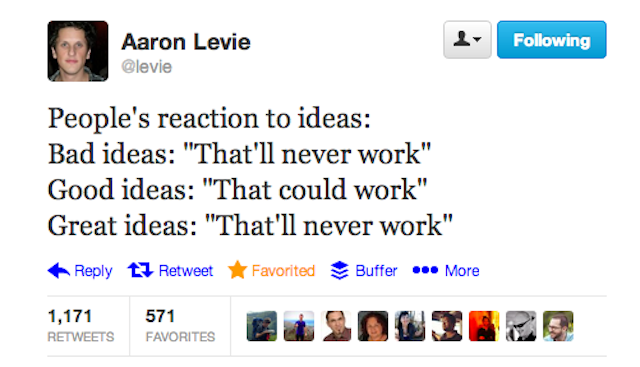
    This thought process is difficult to control because it’s driven by a built-in motivation to reduce uncertainty in our lives. Making a wrong decision is literally painful for our brains to cope with so we tend to seek out ideas that are safer. This tweet by Box founder Aaron Levie sums up how people tend to react to ideas:


    The Incubation Period: the Forgotten Step to Great Ideas

    Many brainstorming sessions are thought of as an end goal—that an answer needs be drawn at its conclusion for it to have “worked.” If the perfect idea doesn’t show itself by the end of the meeting, the brainstorming session is usually deemed a failure. This is in spite of research that show the optimal process for creativity is not within a single group setting with time as the official.

    Creative theorist Graham Wallas presented one of the first models of the creative process in 1926. Wallas noted that our creative process stems from an evolutionary process that allows us to adapt quickly to rapidly changing environments.

    Wallas concluded that the creative process can be broken down into five stages:


      1. Preparation (individual study to focus your mind on the problem and explore its dimensions)
      2. Incubation (the problem enters your unconscious mind and nothing appears to be happening externally)
      3. Intimation (you get a “feeling” that a solution is on the way)
      4. Illumination (your creative idea moves from preconscious processing to conscious awareness)
      5. Verification (your idea is consciously verified, expanded upon, and then executed)

      The problem is, we typically cannot move through this creative process within a single group meeting. Sometimes the incubation stage itself can take days or weeks before you get a feeling that a good idea is on the way. Many of the most creative people in the world validate this, reporting they only arrive at the best solutions after a constant zig zag through alternatives.

      The incubation period can be stressful because there is no clear time as to when inspiration may strike and to make matters worse, it looks like no progress is being made. Sally Hogshead, an author and creative director who helps develop ideas for both Fortune 500 companies and start-ups, even compared the incubation period as a time of doubt leading into agony:


      But coming to terms with how the creative process works is important for it to work. As Albert Einstein noted, “Creativity is the residue of time wasted.”  Being too rigid in the creative process can kill the seeds of exceptional ideas. Joshua Slayton, an engineer at AngelList, shared this slide in a recent presentation, making the case for the importance of removing rules when it comes to creativity:

      Image : Joshua Slayton, Engineer at AngelList Keynote

      Re-Thinking the Brainstorm

      The point of brainstorming is to set aside uninterrupted time to think about how to solve a problem. This doesn’t mean a brainstorming session has to always be done in a group setting to be effective.

      Start with Alone Time

      When you give yourself alone time to ponder an idea, you don’t have to worry about other people’s perceptions, which opens up more creative avenues for you to explore. Scott Berkun, author of The Year Without Pants: WordPress.com and the Future of Work, notes the importance of individual thought to spark creativity in people:
      “Great programmers, designers, and even managers come up with many of their best ideas in the solitary space of their own minds, or when working alone at desks and computers. It’s important to remember that you don’t need a big meeting or some fancy process to generate ideas: a brain, some desire, and some time are all you need.”
      Removing the fear of judgement from others by giving yourself alone time with a concept can help improve your creative output.

      Follow with a Group Session

      Input from someone else or a small group is most valuable once you’ve had some initial time to think about an idea individually. In 2008, research from the University of Toronto showed that group brainstorming can be more effective if people come to a group session after some initial ideas are already cooking. In other words, showing up with a blank slate to a meeting is not as effective as coming in with a few boundaries in place.

      A Better Way

      When I or one of my co-founders setup a group meeting with some initial thought already done, we’ve seen dramatic improvement in the quality of ideas and steps to execution. Most of our blog posts and tools like Unsplash and How Much To Make An App came from initial time spent alone where there was a spark of inspiration before we explored the concepts as a team.

      I’ve since observed a loose format that our most effective group meetings tend to follow. Everything from this list might not work for you but you’re free to take from it what you wish:
      • Allow for tangents. Sometimes going off in different directions during a conversation opens up opportunities for a wide range of connections to be made. Keep the topic in mind but research shows that a few injections of humor and wit along the way can spark novel ideas.
      • No time limit. Why end a meeting early if it’s producing tons of ideas? And why force a meeting if nothing’s coming from it? We’ve had meetings go for a couple hours and others last only a few minutes. However long your meeting is, let it go until you notice the creative output stalling. Then, shut it down.
      • Don’t force immediate conclusions. Ending some meetings without a clear answer is tough but sometimes it’s necessary. When you’re faced with a challenging problem, sometimes it’s best to remove from the problem rather than stare directly at it. The ideas you generate at first may not be the best but letting them sit for a while can provoke new connections, leading you to where the good stuff lies.
      Having a group brainstorming session isn’t wrong but it shouldn’t be thought of as a single event. Instead, group brainstorming should be considered part of a process that includes sufficient time for individual thought.